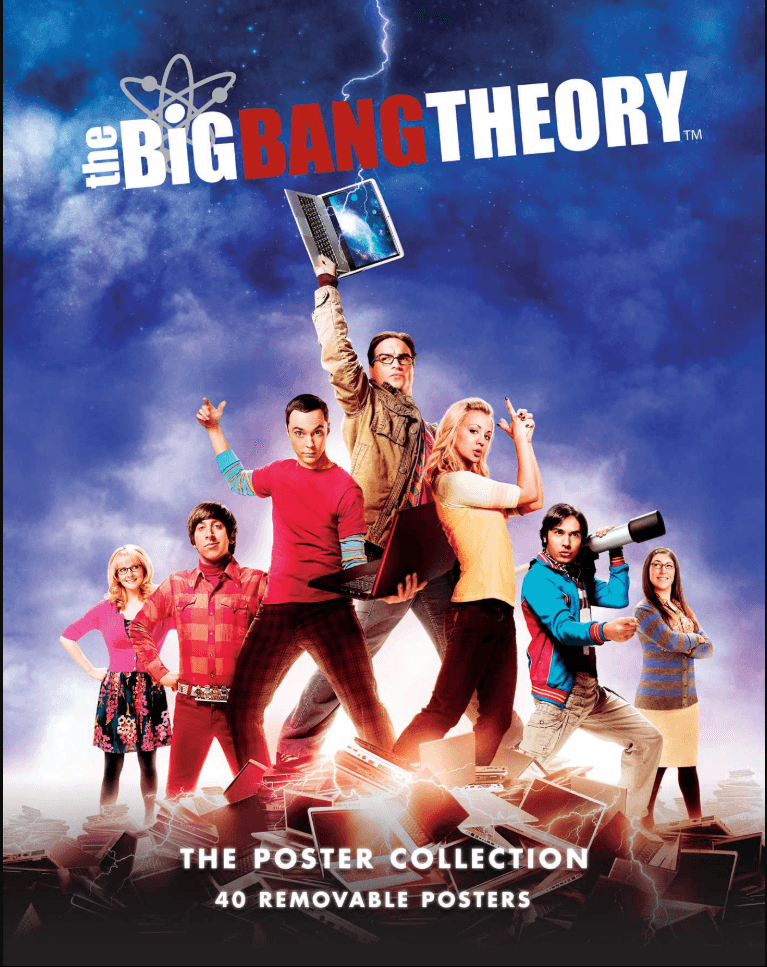
Photo by: Simon & Schuster
"I have spent my whole life avoiding eye contact, small talk, and human interaction. Yet here I am—because friendship means sometimes doing things you do not want to do."- Sheldon Cooper[1]. The Big Bang Theory, created by Chuck Lorre and Bill Prady and directed by Mark Cendrowski in 2007, is a 12-season-long sitcom that follows the life of a brilliant, but socially awkward physicist, Sheldon Cooper, whose lifelong desire is to become a Nobel prize winner. Sheldon and Leonard’s (his roommate and best friend) personal growth journey starts when an aspiring film actress, Penny, moves across the hall from their apartment. The show revolves around Sheldon’s group of geeky friends who navigate the adventure of learning how to self-manage and endure the constant changes in their lives, overcoming their social awkwardness, and finally learning to accept themselves as they are. This 10 Emmy award-winning series would not have been possible without its outstanding cast, starring Jim Parsons (Sheldon Cooper), Kaley Cuoco (Penny), and Johnny Galecki (Leonard Hofstadter) as the three main characters. Although the final season is not what the fans expected, this series perfectly balances intellectual humor and heartfelt moments, intertwining science, geek culture[2], romance, comedy, and heartbreak to make a flawless comedy show.
The series has many meaningful episodes, some of which will make you see the world with different eyes, but I decided to talk about the first part of the two-part-finale: “The Change Constant"[3]. The episode opens with Sheldon, Amy, Leonard, and Penny anxiously awaiting the call that states whether they won the Nobel Prize for their work in super asymmetry. A brief time later they hear the first calls, a prank call from Kripke, and a call from Howard, Bernadette, and Raj to see if they had won. Following that, Sheldon’s phone rang again, it was the call from the Nobel Prize committee saying that they did it, Sheldon and Amy won the Nobel Prize. The remaining episode revolves around Sheldon trying to cope with all the changes that come with winning this prize. Sheldon is a person who lives by a schedule, someone who does not know how to grapple with change, and suddenly from night to morning, everything starts changing. He starts getting a lot of recognition and press coverage, messages from family, friends, and people he hasn’t talked to in years to congratulate him, much more attention at work, Amy’s new look, and the elevator working for the first time in 12 years, things that don’t go well with Sheldon’s nature. Seeing Sheldon overwhelmed Penny takes him to the cheesecake factory. There Penny starts reminding Sheldon that even though he is so afraid of change, he has changed a lot in the last years. She tells him how he and all his friends have changed since they met, and how “the only real constant in life is that everything changes”[4]
I do believe this is one of the most entertaining series I have ever watched, but I often wonder how Chuck Lorre and Bill Prady, two experienced sitcom writers, could design something so incredible. On shocking news, we have a real-life Sheldon Cooper running freely on earth, the inspiration for this incredible show. The Big Bang Theory was inspired by Bill Prady’s experiences working with highly intelligent but socially awkward programmers, which left a question on Prady’s mind: what is the real struggle scientists have with everyday life?[5] So, he partnered up with Chuck Lorre a talented sitcom writer, and creator of Two and a Half Men, to create a series with both sharp humor and emotional depth where we live day by day with a brilliant but socially awkward scientist. The original version of the show did not have Penny, the caring, stubborn neighbor we know and love, but a different version of her named Katie. CBS originally rejected this version; it was not until Lorre and Prady introduced the new re-written version to the company that they decided to take in the show in 2007. There were multiple controversies at the start of the production of TBBT, they did not think a show centered on “nerdy” characters would succeed, but after many adjustments to the concept the network was convinced. [6]
The series' settings are a crucial part of the show's essence as it captures Sheldon’s animosity towards change. The Big Bang Theory has four main settings that never changed: Sheldon and Leonard’s apartment (4A), Penny’s apartment (4B), Caltech University, and the Comic bookstore. Personally, every setting has its specific aspects that add a sense of purpose to the show. Sheldon and Leonard’s apartment, where most of the show’s action takes place, is intended to reflect their nerdy, geeky personalities, filled with science posters, comic books, references to physics, science fiction, and popular culture the characters love. Likewise, the audience can appreciate the uptight nature of Sheldon as the apartment always seems deeply organized. Penny’s apartment, on the other hand, is cozy, colorful, and regularly messy, portraying the contrast to Sheldon and Leonard’s place, reflecting her laid-back and artistic personality. Moreover, the university scenes are typically filmed on set to resemble the real campus of Caltech University, where Sheldon, Leonard, Raj, Howard, and later Amy and Bernadette work. The final key setting is Howard’s comic bookstore. Personally, this is my favorite setting of the show because this is where we can appreciate firsthand the geeky nature of the characters. What I like the most about it is the love Sheldon has for this store. This is the place he was never able to change, not even when a better comic bookstore opened. This place was his second home, the place he would go to hide when things went wrong. [7]
The show followed a classic sitcom structure: the episodes are mostly 20-22 minutes, with self-contained plots and some longer character arcs.[8] In cinematography, the director's use of a multi-camera front, and the live audience played a key role in the show's energy and comedic timing. This method captures genuine audience reactions, making it purer and more authentic. The camera approach customarily involves positioning various cameras around the set to capture multiple angles simultaneously, allowing dynamic scene coverage, close-ups, and wide shots to create a sense of space and capture the character's reactions. [9] Various things make this an astonishing series, but three specific details make it the way it is: the actors/characters, the music, and the costumes. Jim Parsons (Sheldon Cooper): his portrayal of Sheldon was transformative and meticulous. He mastered Sheldon’s quirky mannerisms, rigid body language, distinct speech patterns, and lack of social awareness to perfection, despite being the complete opposite in real life, a tough thing to master as an actor. Jim successfully conveyed Sheldon’s intellectual superiority while also showing vulnerability when it came to the character’s struggle with change and relationships. The directors do think that his comedic timing, deadpan delivery, and ability to show subtle character growth over twelve seasons, were the keys to the longevity of the show. I do believe Jim Parsons was born to be Sheldon Cooper. Johnny Galecki (Leonard Hofstadter): Leonard was the most socially functional of the group, and Galecki played him perfectly with warmth, sarcasm, and emotional depth. I believe the most noticeable ability he has in the show is to portray both frustration and deep loyalty in his friendship with Sheldon, which makes their dynamic one of the strongest in the series. Kaley Cuoco (Penny): Kaley brought natural charisma and comedic timing to the role of Penny, she evolved from the stereotypical “dumb-blonde” to an independent, career-driven woman while maintaining her playful and sarcastic charm. Simon Helberg (Howard Wolowitz): Helberg’s portrayal of Howard combined over-the-top arrogance with hidden insecurities, making him hilarious and sympathetic. His ability to transform the character from a pseudo-womanizer to a loving husband and father was one of the strongest character arcs the show had, and Simon delivered it to perfection. Kunal Nayyar (Rajesh Koothrappali): Kunal perfectly played Raj as both socially awkward and deeply emotional, making him one of the most lovable and funniest characters. Mayim Bialik (Amy Farrah Fowler): Her interpretation of Amy was astonishingly impassive yet charming, making her the perfect intellectual and emotional partner for Sheldon. She brought depth and warmth to a character that could easily have been one-dimensional, showing Amy’s search for love while maintaining her scientific mindset. Melissa Rauch (Bernadette Rostenkowski): Melissa brought an unexpected fierceness to Bernadette, making her lovable and intimidating. With her high-pitched voice and strong-willed personality, she gave the show one of its best female role models.
The music from the show varies from the geeky references, the live audience laugh tracks, and the background scores, to the iconic theme song The History of Everything by Barenaked Ladies. To complement the characters, the Big Bang theory costume designers went face to face with each actor to see what suited the character's essence the best. In the show, Sheldon Cooper always wears superhero and sci-fi T-shirts layered over long-sleeved shirts, along with plaid or khakis pants, emphasizing his geek culture and routine-driven personality. Leonard uses hoodies, jackets, and graphic T-shirts, combined with his more laid-back and nerdier look. Penny dresses casually, with jeans, tank tops, and dresses, reflecting her as “normal” in contrast to the nerdy characters. Howard uses tight-fitting, colorful pants, turtlenecks, and flashy belts. Raj often wears layered sweaters, vests, and earth-toned colors. Ammy wears cardigans, long unfashionable skirts, and layered outfits. And Bernadette wears bright feminine dresses. Each piece of clothing exalts certain personality traits of each character.[10]
Although the final season could have delivered more, this remains one of the best series of the past 10 years. The actors are amazing; the story, the chemistry between the cast, the scenography, the realistic setting, everything is perfect. The show could easily make you feel like you are part of it; hanging out with the “boys” on a game night or the “girls” on a night out, basically becoming part of the gang. It is the perfect comfort series as it mixes friendship, comedy, and warmth. Out of the entire series the most memorable character development is what came out of Penny and Sheldon’s friendship, which shows that the biggest bond there is in life is not the covalent bond, but the friendship bond. Penny is the character who helps Sheldon cope with every wave of thoughts and emotions that he encounters. She understood him, sang to him, and accompanied him in dark moments, and he would take care of her both emotionally and physically. Their friendship took a long journey to get where they end up by the final season of the show, considering that at the beginning, Sheldon would often see Penny as the outsider, the “dumb blonde”, and she became one of his closest friends. But their friendship is not the only one to capture the audience’s hearts, as we can see that even though Sheldon would often annoy Leonard, he has been loyal to him since the beginning. Leonard is Sheldon’s best friend, his favorite roommate, and the brother he wished he had. Through them, the show presents friendship as one of the big themes of the series, and it taught me that friends are the family that we choose, the ones that are not related by blood, but by heart.
2007, 10 Grammys later, unforgettable characters, $1 billion revenue annually and 100 graphic-childish tees later, the big bang theory is a series that will remain in people’s hearts for a very long time. There is always a character or situation that makes it relatable. Personally, after watching the show, I realized that I could relate to Sheldon because, in certain ways, I am like him. I am a person who does not like nor cope well with change, for I am afraid of it. I like things exactly as they are, but The Big Bang Theory taught me another crucial thing; it taught me that “the only real constant in life is that everything changes.” These last episodes are some of the fan-favorites because they show us the end of each character's long personal journey to get to who and what they are in the end. "The Stockholm Syndrome" episode highlights how Sheldon came to appreciate his long-time friends more by showing them his gratitude and remorse at the Nobel Prize ceremony, providing the series the perfect closure. I will always recommend this series, as The Big Bang Theory is a journey you experience alongside the character, especially if you want to learn about true friendship, finding love, growing up, and laughing along the way.
[1] Season 3, Episode 16 of "The Big Bang Theory", titled "The Cornhusker Vortex". Minute 00:18:31.
[2] Peculiar person, especially one who is perceived to be overly intellectual, unfashionable, boring, or socially awkward.
[3] Season 12, Episode 23
[4] The Big Bang Theory: Episode 23 Season 12 “The change constant” minute 16:44
[5] The Creative Coalition. Bill Prady. When Opportunity becomes destiny. February 3, 2021
6 The Big Bang Theory- Chuck Lorre on the origins of the show. The Paley center for media. Filmed March 13, 2013. Uploaded July 21, 2014
[7] The Big Bang Theory Filming Locations – Los Angeles / 2007 Jenna Sims
[8] A character arc is a character's transformation or inner journey throughout a story.
[9] Eyes Of a Generation. Television's Living History. June 6, 2014
[10] Big Bang Theory behind the scenes: Sheldon’s taste in T-shirts. Bronwyn Barnes. October 11, 2012


