
From Code to Consciousness: When Machines Start Thinking. OpenAI ChatGPT, AI-generated image.
At what point does intelligence stop being uniquely human? We built artificial intelligence, and whether we like it or not, it’s evolving. Some support it, saying how it has created the possibility of more efficient workplaces by simplifying many tasks and helping with medical and scientific research. Others oppose to its advancements, arguing that when people ask AI for advice, it’s already programmed to somehow agree with you, or they argue by explaining that machine learning gives AI all the information it supposedly needs, but it doesn’t necessarily know whether all the information is correct or not.
Environmental concerns are a topic of interest among many of those who are trying to figure out whether AI has a more positive or a more negative impact on the world in general. Large AI-focused data centers can evaporate millions of gallons daily, though this water usage varies depending on the cooling technology and location. Some systems that circulate water internally to cool high-density servers can have flow rates of around 2,000 gallons per minute. Roughly 0.13 gallons of water is evaporated for every 10-50 ChatGPT queries, further demonstrating the impact AI tools could have on the Earth’s future.
Should I use a more simple, straightforward vocabulary to make these ideas more understandable?
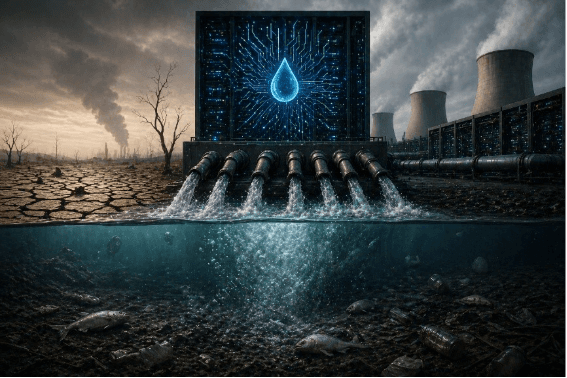
Negative Environmental Impact of AI on Water. OpenAI ChatGPT, AI-generated image.
Despite the environmental issues, there are good things that AI has done for humanity. Artificial intelligence is no longer just solving problems—it is beginning to detect what humans cannot even see. In medicine, AI systems are now capable of identifying the earliest signs of cancer by analyzing patterns hidden deep within medical scans and even fragments of DNA in blood samples. These signals are often so subtle that they escape even highly trained doctors, yet machines can recognize them in seconds. This shift is transforming early detection into something closer to prediction, giving patients a chance at treatment long before symptoms appear. In moments like these, the idea of intelligence evolving from simple code into something almost perceptive no longer feels like science fiction—it feels like a reality we are already stepping into – a new era of technology.
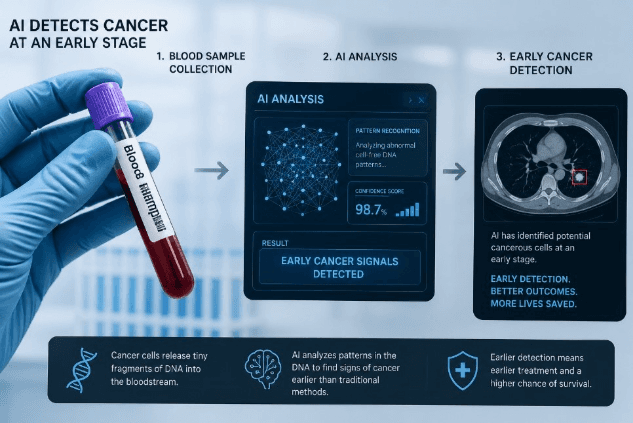
AI Detects Cancer at an Early Stage. OpenAI ChatGPT, AI-generated image.
Oh, right! I forgot to ask you; can you guess which paragraph was almost entirely written by ChatGPT?
There is another issue regarding AI that some people have started to notice but not many speak about it. It’s how AI is trained on human data, and as a result, it can inherit human biases. AI systems are trained on large amounts of human-generated data, so they may reproduce common stereotypes and assumptions. For instance, when asked to generate an image of a doctor, AI has often defaulted to portraying a white male, revealing how deeply ingrained certain societal norms are within the data it learns from. This has led to concerns that AI may reinforce existing inequalities rather than eliminate them. It isn’t intentional bias – it’s learned bias. It mirrors the patterns it is exposed to, highlighting the importance of developing more diverse and representative data.
Artificial intelligence improves efficiency in many aspects of life because of easier access to information and access to a tool that completes basic tasks faster. However, rather than creating new problems – like many people believe it does – it often exposes issues that have existed for a long time. Challenges like academic dishonesty (cheating, copying homework, etc.), over-reliance on technology, and mental health struggles never began with AI, their visibility has only been amplified, and they have also become easier to act on. For example, students have always found ways to copy work, but AI tools have made it quicker and more accessible. In this sense, AI does not invent these problems; it highlights and intensifies realities that society has yet to fully address and it makes them harder to ignore.
By the way, have you noticed now that AI helped me write this article?
Whether AI will inevitably lead to good or bad outcomes is still a topic worth discussing, but not completely determined yet. While it is important to question how objective its information is and the negative environmental impact, it is also important to understand that not all its functions are bad; it has led to great innovations and advancements in our favor. Of course, students should learn to analyze and comprehend information by themselves and use their creativity as often as possible, but teachers should also know that a student using the Oxford comma or a few dashes in their paragraphs are not an immediate sign of ChatGPT or Gemini being used. So ultimately, artificial intelligence is not something to fear outright, but something to question, understand, and guide responsibly. Society should engage with it, ensuring it develops in ways that reflect our values and priorities. In the end, AI is not the problem in itself – it is a reflection of how willing we are to question it, challenge it, and guide it with intention, since its future will not be defined by technology alone.

