
Original cover design
Since the beginning of film, Hollywood has made sure to typecast every kind of character: the bimbo blonde, the snarky best friend, the nerdy geek, the quarterback jock… and about a million more sarcastic characters played by Ryan Reynolds. But for Latina women, stereotyping was never just a comedic trope — it became an identity forced onto them. There’s no surprise that most of these stereotypes revolved around Caucasian actors, especially since in the film industry, one's race played as an undeserved and guaranteed obstacle if it differed from “white”. Nonetheless, as media began progressing, new cultures were introduced into film: Asian, Caribbean, Hispanic, etc. There came the birth of the misrepresented, limited, stereotypical, yellow-filter Latino culture. Hollywood saw an opportunity to profit from socially misjudged stereotypes in Hispanic culture and began generalizing Mexicans as a representation for Latin America. And while that came with the usual Mexican cartel villains or Cancun beach vacations, there’s been one consistent character that, no matter how much society progresses with inclusivity and diversity, has remained prevalent: the hyper-sexualized “Spicy Latina”.
In a plethora of films, Latin-American women have always been typecast as low-income maids who speak but a sliver of English or talk with an overly dramatic mockery of an accent that makes their English barely understandable — and if they’re not maids, they are usually gold diggers or secret agents with overly sexual one-liners next to the male characters who get heroic or sentimental dialogue.
The industry has always been fond of making women flat characters of sexual desire and submissive eye candy for their male counterparts. But when it comes to brown-skinned, Spanish-speaking women, their characterization is not just diluted to their appearance, but to a mockery of their intelligence and capabilities to be anything more than a side character. Latinas are rarely allowed to play intellectual protagonists or characters whose stories are not centered around their ethnicity. The industry overlooks the sheer talent these actresses possess and molds them into a walking stereotype. Sofia Vergara, for example, has been pressured to do nearly every role she plays with a “Latin accent” — whatever that means. She has opened up about how exhausting it is to be constantly typecast as a bombshell Latina immigrant woman with a thick Colombian accent, which leaves little to no room for character depth.
There’s a quote from Sofia Vergara’s Gloria in the sitcom show “Modern Family” that seems to challenge this narrative: “Do you even know how smart I am in Spanish?”. Here, Gloria talks for most, if not all, Latin-American women who’ve been obligated to flee their homes for better opportunities or chase a dream that once seemed far away. This statement shows that Latina women are not forced to meet the absurd traits Hollywood has boxed them into, and it proves that they are smart, witty, and just as deserving of being listened to as those with fair skin and a larger advantage. And of course, you can’t fault the industry for trying to represent different skin colors and ethnicities in media, but you’ve got to know that there is a fine line between inclusivity and travesty.
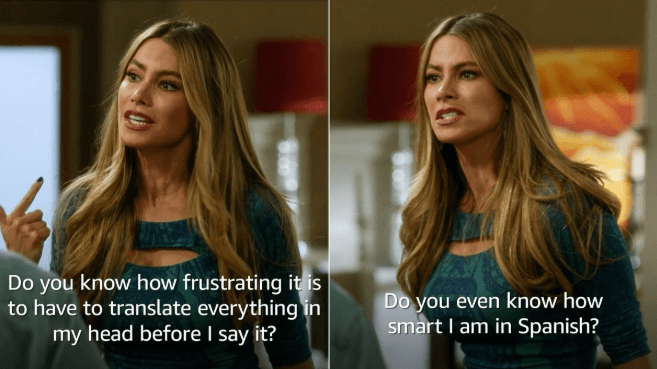
Modern Family. Posted by Prime Video, X, 16 Sept. 2020,x.com/PrimeVideo/status/1305971092008304640.
There’s more than just actresses being limited in the roles they are allowed to play — it’s about the millions of Latin-American girls across the globe who lack representation in an industry that influences and shapes people’s perceptions of different cultures. When they see that, to the entertainment industry — to the world — they are nothing more than hot-tempered sexual magnets with long hair and tight-fitting clothing, both these girls and society begin believing that they’re not allowed to be more than their beauty. This leaves them cutting their dreams short or developing a misconstrued perception of their identity, left not knowing who they are or what they are supposed to be. It goes as far as causing embarrassment for these women — it makes you uncomfortable when the world thinks it controls your sexuality and cultural identity when you yourself haven’t even defined it yet.
There are so many Latina women who have fought to earn a place in this industry. They are proof that women of color can break these stereotypes and make a name for themselves, even if it means working twice, or even thrice as hard as the rest of these actresses. Brilliant women like Salma Hayek, Zoe Saldaña, and America Ferrera continue to uplift women across the globe and be a voice for those whose accents have betrayed their confidence and created judgment for speaking up. To this day, entertainment has a long way to go when it comes to eradicating the deeply rooted racism, sexism, and prejudice it was built on.
Even so, this issue is not just limited to the entertainment industry; it goes beyond film and television. Overly normalized cultural misogyny seeps through the cracks of contemporary society, condemning artists, musicians, actresses, nurses, administrators, CEOs, architects — every single field leaves Hispanic women on the sidelines and looks down on them regardless of their acumen and agility.
There will be a day where the world realizes that the most prideful part of one’s identity comes from the culture that composes it. To leave you with a quote from a woman who suffers most from this preconception: “Soy la nieta de esclavos que se atrevieron a soñar. Soy la hija de inmigrantes que desafiaron el status quo. Soy un símbolo de esperanza y resiliencia”. — Sonia Sotomayor, the first Latina and the third woman, to serve on the Supreme Court of the United States.

Valeria Hernandez
Junior writer
Hi, I’m Vale! I’m a junior at La Floresta and an editor and writer for The Daily LF. Writing has always been my favorite way to explore the world—it lets me dive into different perspectives, cultures, and stories that shape how we understand one another. I love leaving a piece of myself in everything I write and hope my voice stands out through my words. More than anything, I want my writing to spark thought, emotion, and connection. I’m so excited to keep growing, learning, and sharing my passion with all of you!

