
From: Getty Images
“Times are changin’,” as once said by the infamous legendary icon, Prince, who made sure he became the face of change for what it meant to be a Black artist — a Black man — at a time where they were only allowed to fit one category. Prince symbolized more than just art; he symbolized breaking a cycle in an industry that leeched off Black people as tools rather than treating them as people. His career became a fight for individuality, ownership, and identity in an industry that historically limited the control Black artists had over their own work.
Since before he was born, he was destined to be a once-in-a-lifetime star with unique artistry and bold messaging. His father, John Nelson, was a jazz musician who played under the stage name Prince Rogers in The Prince Rogers Trio. When he had a son with the trio’s singer Mattie Della Shaw in 1958, he gave the baby his stage name, making him Prince Rogers Nelson. In a 1991 interview, John Nelson explained his choice: “I named my son Prince because I wanted him to do everything I wanted to do.”
Prince’s father lived in a time where systematic racism prevented him from reaching stardom, a time where White artists plagiarized the work of African American creatives and stole their success because of the color of their skin. For instance, Big Mama Thornton’s 1952 song “Hound Dog” reached #1 on the Billboard R&B chart for seven weeks and sold two million copies, yet Elvis Presley’s 1956 cover topped the pop, country, and R&B charts simultaneously for 11 weeks and sold over 10 million copies. The industry had a pattern — profit from Black talent, but limit their control.
By the age of 7, the small boy from Minneapolis, Minnesota had taught himself to play the piano, guitar, and drums. He continued polishing his skills until 1978, when he released his debut album For You, showcasing just how multifaceted he was — a songwriter, singer, producer, and artist who created his own sound. On many of his recordings, Prince played nearly every instrument himself, sometimes performing more than twenty instruments in a single session. With mixes of hip-hop, funk, jazz, and pop, he dived into his own genre, refusing to accept the narrative that Black artists had to remain boxed into one category.
Following the circulation of his demo tape, record executives from Warner Brothers Records, A&M Records, and Columbia Records came running with offers in hand. Prince, then only 15 years old, turned them down. When questioned about his decision, he stated, “They wouldn’t let me produce myself.” His main concern had always been individuality. After many offers, he signed with Warner Bros, unaware of the legal dispute he would face years later.
People were scandalized by his bold lyricism and flamboyant performances. It made them uncomfortable to see an artist step outside the role society cast for him. Black men in the industry were often expected to embody hypermasculinity — thick chains, baggy clothes, diamond rings. So the visual of a Black man with curly dark hair, colorful fashion, high heels, and dark eyeliner caused commotion. Prince’s style was one of the most significant aspects of his identity, so much so that he became inseparable from the color purple. Inspired by his 1984 film Purple Rain, the hue represented royalty, mystery, non-conformity, and artistic rebellion. The film and its soundtrack became a cultural phenomenon, winning an Academy Award and turning Prince into a global superstar. It symbolized his fusion of sexuality, spirituality, and musical genius — boundary-breaking and gender-bending, yet authoritative.
Prince’s impact on music was undeniable. In 2004, he was inducted into the Rock and Roll Hall of Fame, where he delivered a legendary performance of “While My Guitar Gently Weeps” alongside Tom Petty, Jeff Lynne, Steve Winwood, and Dhani Harrison. His electrifying guitar solo became one of the most iconic moments in Hall of Fame history, proving his virtuosity and influence among the greatest musicians of all time.
Despite his success, Prince faced a major conflict with his record label. Warner Bros claimed legal control of Prince’s masters, meaning the corporation controlled how his music was used and licensed. For Prince, the inability to control his own art was a threat to his artistic integrity. He believed it was a grave injustice that a corporation benefited financially from work they did not create. “If you don’t own your masters, your master owns you,” he told Rolling Stone in 1996. In protest, he appeared in public with the word “SLAVE” written on his cheek and later changed his name to an unpronounceable love symbol. Both actions read one message: he refused to let the industry strip him of his identity and individuality. The conflict lasted for years during the 1990s, becoming one of the most visible battles over artistic ownership in the music industry.
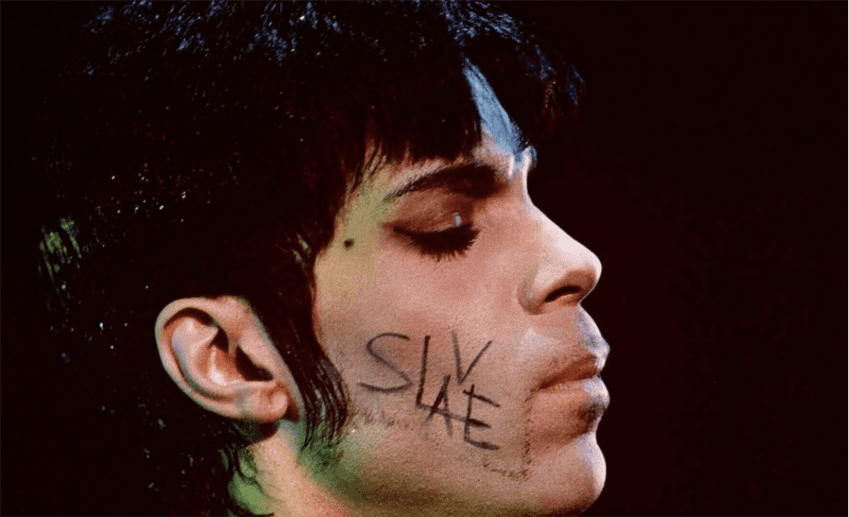
Photograph: Brian Rasic/Rex Features
Even after his death on April 21, 2016, Prince’s legacy continued to shape culture. In 2017, the Pantone Color Institute, in collaboration with Prince’s estate, created an official custom shade of purple named “Love Symbol #2,” inspired by his purple Yamaha piano. The color became a permanent tribute to the artist who had made purple synonymous with rebellion, creativity, and identity.
Today, Prince’s fight for ownership still echoes across the music industry, as modern artists continue to advocate for control over their masters and creative work.
Prince did not just create music. He challenged an industry that had long controlled Black artists and their art. Through protest, purple, and persistence, he made sure times truly were changing.

Valeria Hernandez
Junior writer
Hi, I’m Vale! I’m a junior at La Floresta and an editor and writer for The Daily LF. Writing has always been my favorite way to explore the world—it lets me dive into different perspectives, cultures, and stories that shape how we understand one another. I love leaving a piece of myself in everything I write and hope my voice stands out through my words. More than anything, I want my writing to spark thought, emotion, and connection. I’m so excited to keep growing, learning, and sharing my passion with all of you!

