Smith, Patrick. “The Super Bowl Kendrick Lamar Halftime Show.”
The “revolution” was indeed televised, at the right time, by the right guys. The Super Bowl is arguably the most relevant American sport-related event of the year, showcasing approximately three hours of football and “blue, white, and red” pride, with a fifteen-minute musical intervention known as the half-time show. But what does it mean to be a true American? The answer to this question can be found in the Super Bowl halftime show stage. In the last few years, this halftime show has been used as an activism platform, a place where artists can convey a message and bring attention to the importance of their culture.
Two of the most watched half-time shows in the history of the Super Bowl are Kendrick Lamar (2025) and Bad Bunny (2026), averaging 133.5 million viewers and 128.2 million viewers respectively. Both artists have used their fifteen-minute onstage to make a statement, to show the world that there are issues to be resolved and to make a call-to-action on the injustice that millions of people face in their day-to-day life. Bad Bunny and Kendrick Lamar navigate a reprimand on social injustice in their presentations through language, imagery and symbolism. Whether it’s Samuel L. Jackson or Toñita,, both shows were filled with symbolic people and elements fundamental to each artist’s culture, and every part of the show speaks a loud message to the audience leaving plenty to talk about after the show is done.
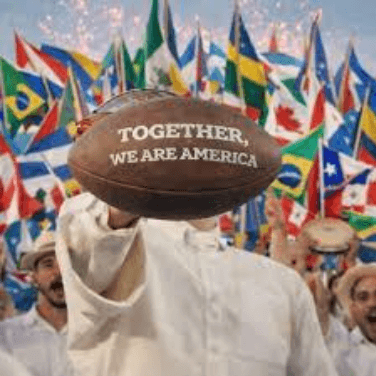
Image 1 “Bad Bunny’s Apple Music Super Bowl Halftime Show. 2026.”
In Kendrick Lamar’s show, Samuel L. Jackson, dressed as Uncle Sam, leads the show, instructing him on “the rules of the game.” At one point, Uncle Sam intervenes the presentation with the phrase “no no no too loud, too reckless, too ghetto”, a phrase that is rich with connotation. By having Uncle Sam, a representation of American values, call him out for being “too ghetto” Lamar showcases how his culture has been looked down upon for generations, being called out simply because they don’t fit white standards, and minimizing their right to self-expression just because they are different. Likewise, Bad Bunny uses language to raise the voice of his people against the turmoil of oppression that has been going on recently with the ICE raids. At the end of the show, the words “the only thing more powerful than love is hate” were shown in the big screen, right as he stated “God bless America” and brought out the flags of all the countries in the American continent. From Chile, all the way to Canada, Bad Bunny used his voice to invite people to fight hate with love, to show the world that social injustice can be eradicated through compassion, empathy, celebration of life and family.
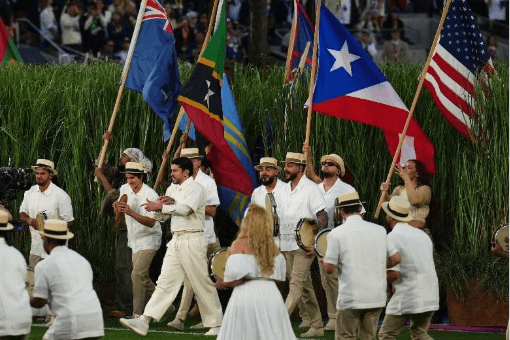
Image 2. Credits to Vazquez, Godofredo. Bad Bunny brings Puerto Rico to the Halftime Show.
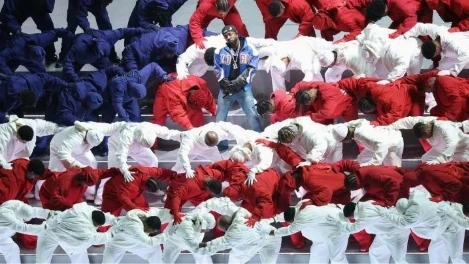
However, language is not the only tool to turn a fifteen-minute presentation into a historical showcasing of heritage. Kendrick Lamar uses all-black male dancers to put a United States flag on the stage, singing in the middle and splitting the human flag in half. This visual element portrays how “America” has always been sustained by African American labor; the flag implies that America is built by black people. Additionally, the fact that the flag is split in half symbolizes the message that a supposedly united nation is split right down the middle, with ideologies that enhance the use of violence as a resource for consolidating domination. On that same note, Bad Bunny’s half time show was rich with imagery and connotation, using unstable light poles in his song “El Apagón” to showcase that Puerto Rico faces a lot of hardships and precarious conditions, and even when faced with trouble, Latinos find positiveness in their situation. The two examples afore mentioned are mere specs of the imagery used in the shows, both are just that, examples of the richness behind activism in the media.
Lastly, each of these shows is packed with symbolism, one of the strongest elements both artists use to showcase a their message. In Kendrick Lamar’s performance of “All the Lights” with SZA, he uses a circle stage with a sloped staircase that takes the artist from the bottom, to the top and back to the bottom. This stage symbolizes that, no matter how hard they try, African Americans always end up at the bottom, marginalized and discriminated by American societal norms. On the other hand, Bad Bunny uses a football with the words “together we are America” as a symbol of union and love. The football, representing one of the most “American” events of the year, is engraved with a message that shows his perspective on real American values, an invitation to celebrate diversity and embrace the cultural richness that characterizes the continent.
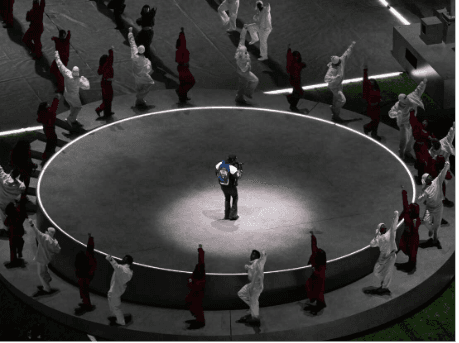
Ord, Cindy. “The Super Bowl Kendrick Lamar Halftime Show.”
All things considered, Kendrick Lamar and Bad Bunny were given a one in a lifetime opportunity, a chance to bring awareness in a platform where millions of people are listening. Regardless of their different cultures, both artists delivered a world-class show that will always be remembered, a presentation where minorities could feel their voices being heard, a presentation that took performance to the next level and turned it into a statement never to be forgotten, remiding that the voice of the people will always be heard.

Ariana Salazar
Junior writer
Hi, I'm Ari! I'm a junior at La Floresta and a creative writer for the school newsletter. I've always loved plastering my thoughts in writing, and being a part of The Daily gives me a chance to do that. I'm excited to share my writing and ideas with everyone. Being part of this project has helped me improve my writing skills, and especially connect with people who are as passionate about writing as I am. I hope my articles serve as inspiration for people and encourage someone to share their valuable thoughts with the world.

